


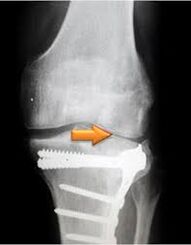
Knee pain is most often a manifestation of osteoarthritis of the knee joint.This disease affects millions of people around the world.But an endoprosthesis is not always required!There are new effective treatments for knee degenerative processes that address both the causes and symptoms.The most important thing for every patient is to know the causes and symptoms of the disease and the possibilities of its treatment.
Where does knee pain come from?
Degenerative knee disease (arthrosis, degenerative changes, osteoarthritis) is a condition of chronic inflammation of the joint.Although age is the main risk factor, unfortunately, the disease can also affect people at very young ages.As a result of inflammation, first of all, cartilage is damaged, as well as ligaments, meniscus and other joint structures.However, it is the loss of cartilage tissue that determines to the greatest extent the aggravation of the development of arthrosis.The natural shock absorber between bones, which is cartilage, becomes weakened.When this happens, the bones inside the joint move closer together (loss of cartilage thickness) and rub against each other.The ends of the nerve fibers, which are exposed due to loss of cartilage thickness, are irritated with every movement.Friction causes pain, swelling (visible on ultrasound and sometimes even to the naked eye), stiffness, decreased mobility, and later the formation of bone spurs called osteophytes (visible on X-rays and ultrasound).The basis of this disease is chronic inflammation that destroys cartilage.Skillful management of inflammation, cartilage regeneration and care for the biomechanical properties of the joint (rehabilitation) play a decisive role in controlling the progressive disease.
Who is affected by osteoarthritis, a degenerative joint disease?
Joint arthrosis is the most common type of intra-articular inflammation.Although the disease can occur even among young people, the risk increases after age 45.Numerous studies show that osteoarthritis of the knee joint is one of the most common.The study also shows that women are more prone to arthrosis.
Causes of knee arthrosis
The most common cause of knee osteoarthritis is age.Almost all of us experience some degree of degenerative changes at some age.However, there are a number of factors that increase the risk of significant osteoarthritis, even at a younger age:
- Age– the ability of cartilage tissue to regenerate decreases with increasing age.At the same time, the number of cycles of the joint increases, micro-overloads accumulate, and sometimes serious injuries.
- Overweight– Excess body weight increases the load on the knee joint.Each extra kilogram loads your knees by another 3-4 kg.Abnormal fat tissue produces substances that travel through the blood into the joint and cause damage.
- Atherosclerosis(poor blood supply to the subchondral bone, bone infarctions)
- Diabetes
- Hormonal disorders– it has been proven that losing body weight by 5 kg can reduce pain by even 50%.
- Hereditary factor– genetic factors play an important role in the development of osteoarthritis.The occurrence of arthrosis or rheumatic disease in parents significantly increases the risk of the disease in the patient.An incorrect axis (“curvature”) of the limb can also be inherited, causing overload of this knee compartment and the development of degenerative changes.This occurs in case of valgus or varus deformity of the knee.
- Floor– Women over 55 years of age are more likely to get sick than men of the same age.Hormonal factors influence.
- Injuries and overload– As a rule, injuries depend on the type of activity a person does.People who perform work while kneeling, squatting, or lifting heavy objects are more likely to develop degenerative changes due to frequent and improper loading and pressure on joint surfaces.
- Sport– professional athletes, especially in sports disciplines such as football, tennis, basketball or sprinting, are at increased risk of developing osteoarthritis of the knee joint.A large group of our patients are also people who practice recreational sports, but often very intensively.Among them, runners have the most problems with their knees (and feet).This means that athletes must take every precaution to avoid injury and overuse.Much can be achieved by relatively simple means.It is important to remember to do regular and moderate strengthening exercises and stretching.In fact, it is weak muscles surrounding the knee that reduce its stability and lead to faster cartilage wear and degenerative changes.Improperly trained muscles easily contract, creating overload in tendons, entheses (places of attachment to bones) and ligaments.The biomechanics of the joint damaged in this way accelerates the “wear and tear” of its elements.It is necessary to adjust training, recovery after it, diet, sometimes nutritional supplements and intra-articular injections of special drugs (hyaluronic acid, platelet-rich plasma PRP).
- Other reasons– People suffering from rheumatoid arthritis, which is the second most common type of joint inflammation, are more likely to develop osteoarthritis.These patients require, first of all, proper treatment of the underlying disease by a rheumatologist, as well as comprehensive multi-orthopedic procedures.In addition, people with certain metabolic disorders (such as those resulting from excess iron or growth hormone) or connective tissue disorders (such as constitutional joint hypermobility) are also at increased risk for osteoarthritis.Blood inside the joint greatly damages the cartilage, so hemophilia can lead to serious damage and the need for joint replacement.
When conservative treatment does not bring results, surgery to replace the joint with an artificial knee endoprosthesis (also called alloplasty) is indicated.
Symptoms of arthrosis of the knee joint
This disease progresses differently depending on severity, age, physical activity and other predispositions, but by far the most common symptoms are:
- pain in the knee joint that increases with activity and decreases with rest.It is caused by the opening of the free nerve endings of the subchondral bone of damaged cartilage
- knee swelling
- feeling of warmth in the joint
- stiffness in the knee, especially in the morning or after a long time of immobility, such as after sitting in the office or watching TV
- a decrease in the range of motion of the knee joint (eng. ROM. - Range of Motion), which makes it difficult, for example, to get up from a chair or get out of a car.Difficulty going up and down stairs, and later even walking.
- creaking, crunching, or popping sounds in the knee, especially as a result of sudden movement of the knee joint
- many people also say that weather changes affect the degree of pain and joint function.
How can arthrosis of the knee be diagnosed?
The diagnosis of osteoarthritis of the knee is based primarily on a description of the patient's medical history, an accurate description of current symptoms, and an orthopedic examination.In a conversation with your doctor, you should pay attention to what leads to increased pain and what relieves it.You should also find out if anyone in the family has previously suffered from osteoarthritis or rheumatoid diseases.
Your orthopedic surgeon may recommend additional tests, including:
- X-ray, which shows the severity of bone lesions, including: narrowing of the joint space, osteophytes (bone spurs), subchondral sclerosis, sharpening of the intercondylar eminence, abnormal limb axis.
- Ultrasound- click here to find out more.
- MPT- magnetic resonance imaging - is performed most often when x-rays and ultrasound do not show a clear cause of pain in the joint.
- Blood test- to eliminate other causes of diseases, such as rheumatoid diseases, Lyme disease (boreliosis), etc.
Treatment methods for arthrosis of the knee joint
The development of orthopedics in recent years has opened up new opportunities for extremely effective treatment of osteoarthritis of the knee joint.It is increasingly possible to delay or even cancel the stage of replacement surgery (knee replacement) through the use of modern methods and treatment with growth factors (GPS = PRP, Platelets Rich Plasma).These methods use the body's natural ability to inhibit osteoarthritis and strengthen articular cartilage.
The most important goals of treatment for knee osteoarthritis are pain relief and restoration of range of motion along with mobility.The treatment plan must be selected individually.Additionally, treatment usually contains a combination of the steps described below.
Conservative treatment (non-surgical)
- Loss of body weight.Losing even a few pounds can significantly reduce knee pain.
- Exercises.Strengthening and stretching the muscles around the knee provides greater stability, proper biomechanics and reduced pain.
- Analgesics and anti-inflammatory drugs.There are many drugs on the market that help reduce pain and inflammation (called NSAIDs - Non-Steroid Anti-Inflammatory Drugs).But keep in mind: You cannot use painkillers for more than 10 days without consulting your doctor.Taking them for longer increases the likelihood of side effects.The most important of them are:
- bleeding from the upper gastrointestinal tract (stomach and duodenum) - especially in the USA, where the availability of NSAIDs is high, and the availability of a doctor is much less, and bleeding becomes a common cause of death,
- peptic ulcer of the stomach and duodenum (destruction of the gastric mucosa by hydrochloric acid contained in gastric juice),
- gastritis of the stomach and duodenum,
- decreased blood clotting (possible bleeding),
- renal failure,
- bone marrow destruction.
This is why it is so important to use other methods that do not cause systemic side effects.
- Corticosteroid injections, called steroid knee blocks.Steroids are powerful anti-inflammatory drugs and relieve pain.Unfortunately, they have very negative systemic effects (for example, hormonal disorders, diabetes) and local (irreversible damage to articular cartilage!).Therefore, this form of therapy should be reserved only for patients who are scheduled to undergo knee replacement surgery (arthroplasty) within a short time.
- Ultrasound intervention.Injection of the area affected by the disease with the appropriate drug under ultrasound guidance.A very effective form of therapy, which, however, requires high qualifications and experience from an orthopedic doctor.
- Injections of hyaluronic acid, so-called viscosupplementation.Hyaluronic acid is given by injection into the knee joint and increases the viscosity of the synovial fluid, and therefore its lubricating properties.Reduces friction between cartilage surfaces, knee pain, popping and stiffness, often improving range of motion.
- Tablets with glucosamine, collagen, chondroitin.Research has not proven their effectiveness, although they are very common.
- Anti-inflammatory ointments.These ointments are used externally and can bring temporary relief.Their action, however, is significantly limited by weak penetration into the joint through the barrier of the skin, subcutaneous tissue, fascia, etc.Sprays provide better penetration of the drug.
- Stabilizers and orthoses of the knee joint.Indicated mainly for damage to the anterior cruciate ligament (ACL - Anterior cruciate ligament) or other ligaments.They help maintain better stability of the knee joint, thereby preventing further damage to the cartilage and meniscus.
- Physiotherapy.A very important part of the therapeutic process.Strengthening and stretching exercises are often necessary.Massage and manual therapy performed by an experienced physiotherapist are the most important.Physical therapy (eg cryotherapy, ultrasound, iontophoresis or TENS currents) works supportively.Acupuncture, which is already used in daily hospital practice in Germany, can also have an effect.Your physical therapist will teach you ways to improve muscle strength and joint flexibility at home.He should also show you how to perform basic exercises every day without putting too much strain on your knees.
Surgical treatment
The operation has a number of advantages, as well as disadvantages.With the right qualifications for surgery (correct assessment of the damaged structures and the possibility of their restoration), significant improvement can be achieved quickly.Each operation, however, carries a risk, therefore, it is performed only when the degree of damage to the intra-articular structures is severe, and conservative treatment methods do not provide a positive effect.The most commonly performed procedures for knee osteoarthritis include arthroscopy, osteotomy, and knee replacement.
- Arthroscopy– minimally invasive endoscopic procedure.It ensures safe restoration of most intra-articular structures.Through two small (several millimeters) skin incisions in the front of the knee, a longitudinal camera and instruments are inserted into the knee.This procedure is often performed in athletes (complex reconstructions of ligaments, cartilage, meniscal suturing) and in the case of relatively young patients with the initial stage of arthrosis (usually under 60 years of age).In the first case, it becomes possible to return to professional sports in a short period of time, in the second, discomfort is reduced and the patient is shifted in time or the need for endoprosthetics is eliminated.
- Osteotomy– a procedure for “cutting” the bone, correcting the axis of the limb and merging the bones.In this way, the painful part of the knee, most often the medial part, is relieved (it is the part that is most often damaged).Osteotomy is often recommended for a fracture in the knee area (eg, a proximal tibia fracture) if it has not been properly treated.The success of such an operation largely depends on the correct classification of the patient and the proper execution of the procedure itself.The advantage is the time shift in the need for endoprosthetics, the disadvantage is the need for long-term immobilization in plaster to allow the bone to heal.
- Knee replacement(alloplasty, endoprosthetics) is a major surgical operation in which the ends of the articular bones are cut out in the proper way, then the metal parts of the prosthesis are placed on them (on the so-called bone cement or only mechanically).The new articular surfaces form so-called linings: made of polyethylene, ceramics or metal.One part of the knee (medial) or the entire knee joint may need to be replaced.The goal of the surgery is to restore greater mobility and eliminate pain.This is what happens in most cases.However, this is a large and cumbersome operation for which the patient must be well prepared.Complications, although rare, can be very serious (including bone infections, implant loosening, thromboembolic complications).Therefore, knee replacement should be reserved for people over 55 years of age with severe osteoarthritis in whom proper and intensive conservative treatment has not produced the expected results.This operation is contraindicated in older people, with heart or respiratory failure, hormonal disorders (mainly related to the thyroid gland), after a stroke or other serious internal diseases.These patients are offered intensive conservative treatment.However, according to statistics, despite some risk, the overall results of surgical operations for implantation of an endoprosthesis in recent years are very good.
Therefore, the importance of early diagnosis and regular contact with a podiatrist should be emphasized.The best alternative to surgery remains treatment with growth factors PRP, viscosupplementation and individually selected, professional rehabilitation.In my practice, I monitor the progression of osteoarthritis and select appropriate treatment in collaboration with high-quality radiologists, rheumatologists and physiotherapists.